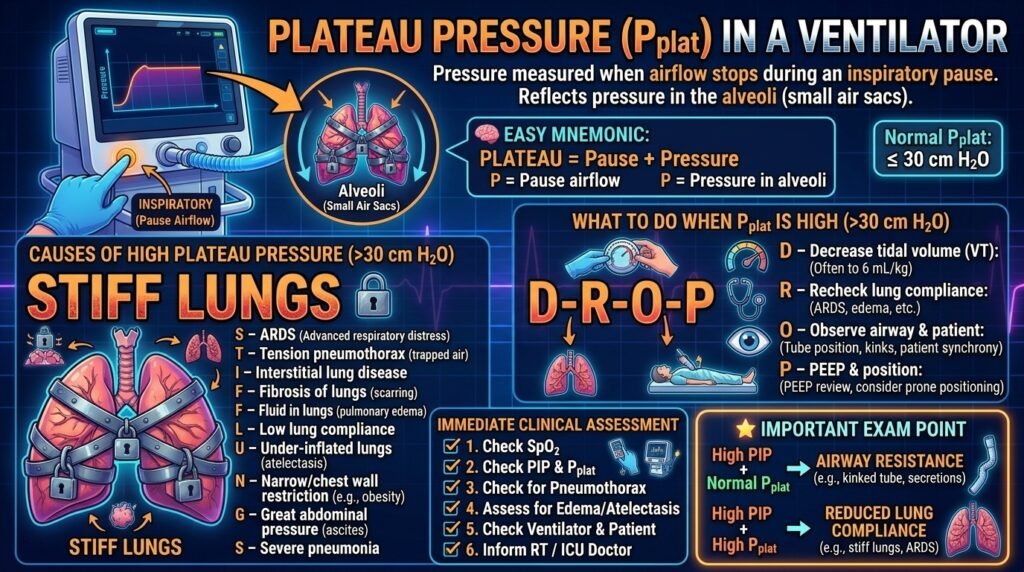
Pressure measured when airflow stops during an inspiratory pause.
It reflects the pressure in the alveoli (small air sacs).
 Easy Mnemonic:
PLATEAU = Pause + Pressure
P = Pause airflow
P = Pressure in alveoli
Remember: Plateau pressure = pressure when air is NOT moving.
Normal Pplat: ≤ 30 cm H₂O
High plateau pressure: >30 cm H₂O
Mnemonic: STIFF LUNGS
S – ARDS
T – Tension pneumothorax
I – Interstitial lung disease
F – Fibrosis of lungs
F – Fluid in lungs (pulmonary edema)
L – Low lung compliance
U – Under-inflated lungs (atelectasis)
N – Narrow/chest wall restriction (e.g., obesity)
G – Great abdominal pressure (ascites)
S – Severe pneumonia
Important: Pplat >30 cm H₂O
Goal: Reduce pressure and protect the lungs from injury.
Easy mnemonic: D-R-O-P
D – Decrease tidal volume (VT): Clinician may reduce VT (often toward 6 mL/kg predicted body weight).
R – Recheck lung compliance: Look for ARDS, pulmonary edema, pneumonia, etc.
O – Observe airway and patient: Check tube position, secretions, kinks and patient-ventilator synchrony.
P – PEEP and position: Review PEEP, consider prone positioning in severe ARDS, and optimize patient positioning.
Immediate clinical assessment
Check oxygen saturation (SpO₂).
Check peak pressure (PIP) and plateau pressure (Pplat).
Check for pneumothorax.
Assess for pulmonary edema or atelectasis.
Check ventilator settings and patient condition.
Inform the respiratory therapist/ICU doctor promptly.
Important exam point
Finding
Possible problem
High PIP + normal Pplat
Airway resistance
High PIP + high Pplat
Reduced lung complianc